School ends, the front door opens, and suddenly the floor has a backpack, two shoes that are somehow not a pair, a lunchbox, and a paper you were supposed to sign yesterday. The answer is not a custom mudroom. It is one small landing spot that gives each thing an obvious next move.
This no-buy after-school drop zone works with a hallway, a corner of the kitchen, or even the back of a door. Use what you already own first. The goal is not to make your home look like a catalog; it is to make tomorrow morning a little less ridiculous.
What a Drop Zone Actually Needs
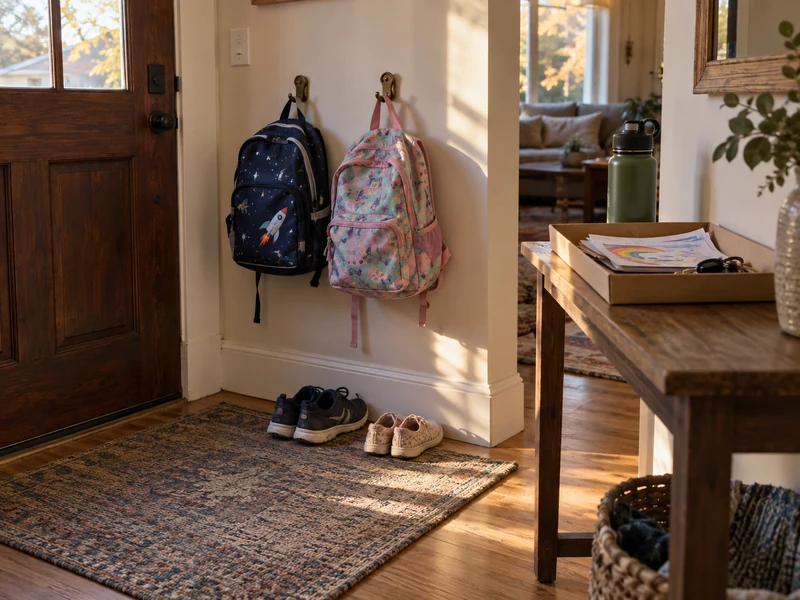
Keep it to four destinations: a place for the backpack, a place for shoes, a place for papers that need an adult, and a route for the lunchbox and water bottle to reach the kitchen. Those last two should not live by the door overnight. A pile with cute baskets is still a pile if nobody knows what goes where.
Choose the spot where bags already land, provided it does not block a door or walking path. Do not make children cross the house to use your “perfect” setup. An existing coat hook, a sturdy chair back, or a reachable shelf may do the job. If you install new hardware later, follow its weight and mounting instructions; a heavy school bag is not a good experiment for a weak adhesive hook.
Set It Up Without Buying a Thing
1. Clear a Backpack-Sized Patch
Remove the items that have quietly claimed this space: old mail, outgrown shoes, a mysterious winter hat. You need enough room for a child to stop, take off a bag, and put it away without tripping. That may be one wall and a mat, not an entire entryway makeover.
If your entrance is too narrow, put the bag spot on the first safe wall inside the living room or kitchen. “Near the door” is useful; “in everybody’s way” is not. Give the spot a one-week trial before moving furniture or buying bins.
2. Put the Backpack Where a Child Can Reach It
Use an existing low hook, sturdy rack, or shelf that can safely hold the packed bag. Let the child try hanging it while wearing shoes and carrying the usual after-school load. If they cannot reach or manage the hook, the system will become your job by Tuesday.
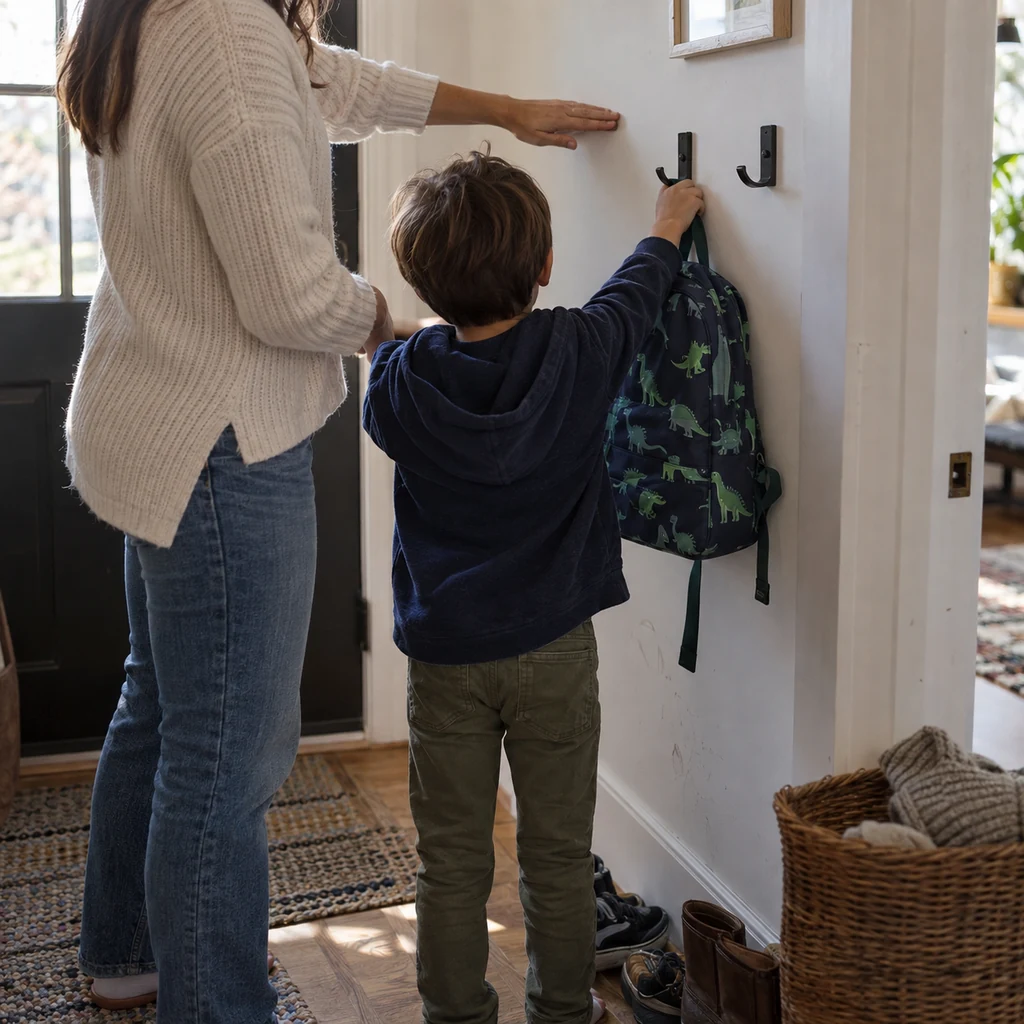
One home for each regularly used backpack is enough. Keep sports bags and occasional gear somewhere else so the daily station does not become a storage museum. If the hook is temporary, check it frequently and switch to a floor shelf or sturdy chair if it will not hold the load.
3. Give Shoes a Visible Boundary
An old washable mat, shallow tray, or one section of an existing shelf creates a boundary. Assign space for the shoes worn most school days, not every pair the child owns. When there is room for twenty shoes, twenty shoes will eventually show up. This is less a design principle than a threat.
Keep wet footwear on a surface that can dry and be cleaned. Do not pack damp shoes into a closed basket and hope for the best. If shoes are not removed in your household, use this zone for coats or another item that otherwise blocks the entrance.
4. Make School Papers a One-Tray Decision
Use one shallow tray, folder, or spot on the counter for papers requiring your action: forms to sign, dates to add to the calendar, and messages to answer. Art you want to keep goes elsewhere; recycling goes straight to the recycling bin. A tray that holds everything forever is just a prettier floor pile.
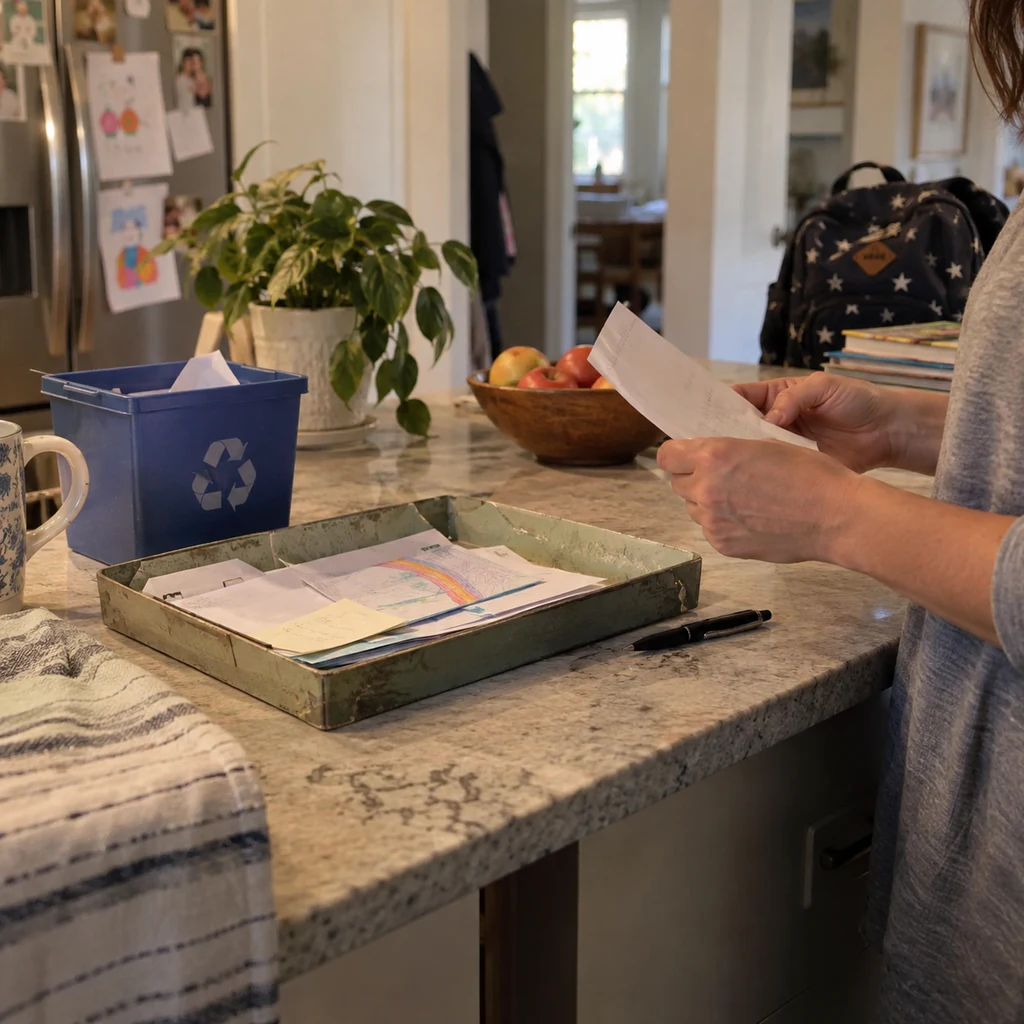
Do a quick check the same time each day, perhaps while lunchboxes are emptied. Put deadlines into the calendar immediately, then return signed forms to the backpack before bedtime. This is the least glamorous part of the system and probably the one that saves the most frantic mornings.
5. Send Food Containers to the Kitchen
The drop zone is a transfer point, not long-term lunchbox storage. Have your child carry the lunchbox and water bottle to the sink or kitchen counter after hanging the bag. Empty leftovers, handle any perishable food appropriately, clean containers as needed, and set the dry bottle where it will be refilled.
If your child is young, make the job smaller: “Put your bottle by the sink” is more likely to happen than “unpack your things.” An older child may be able to empty the whole bag independently. The right routine is the one they can repeat, not the one that sounds impressive online.
The Two-Minute After-School Reset
Practice the route together for a few days: shoes to the mat if your household removes them, backpack to its spot, lunch items to the kitchen, action papers to the tray. Stop there. Homework, snacks, and conversation can happen after the doorway is clear. A routine with four moves has a fighting chance; a twelve-step command issued to a hungry child does not.
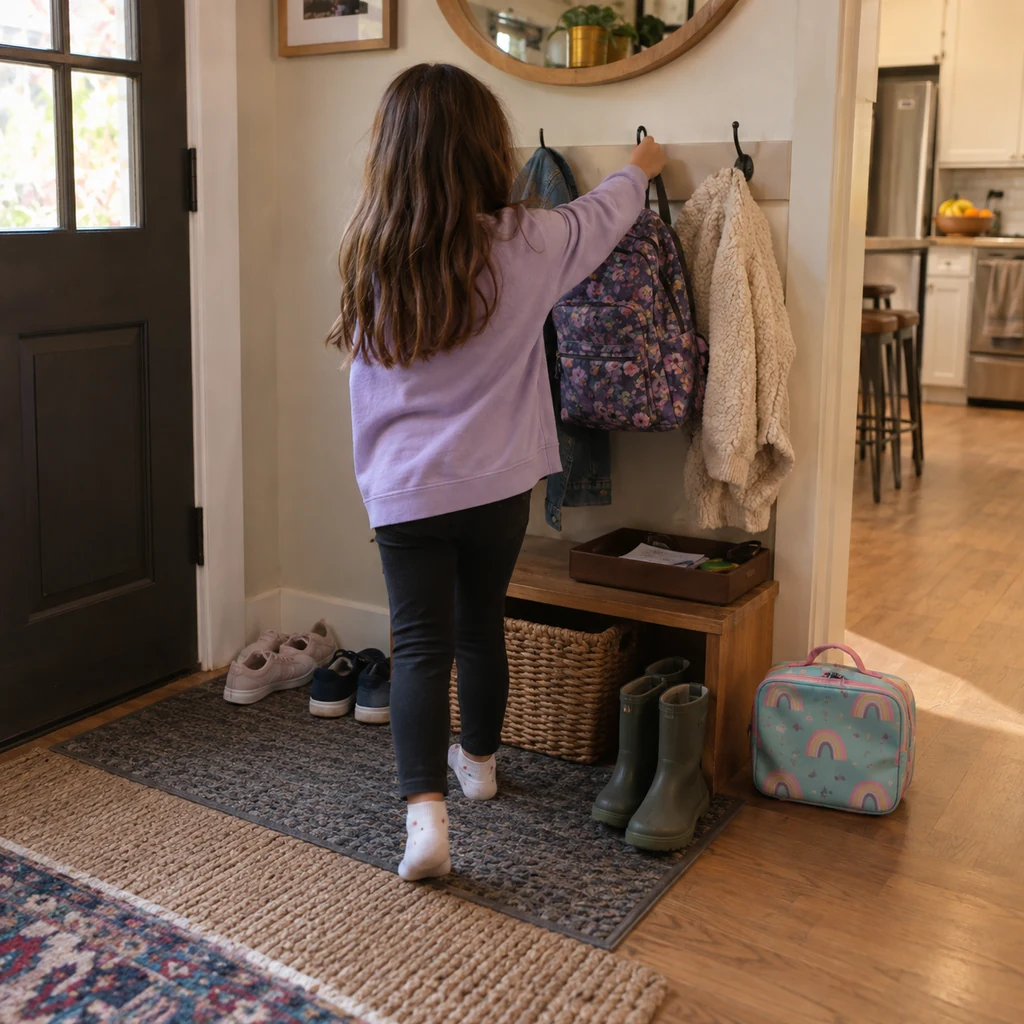
For the first week, stand nearby and point to destinations instead of repeating “clean up your stuff.” If the backpack repeatedly lands on the floor, ask why. Is the hook too high? Is the bag too heavy? Is the tray hidden? Fix the obstacle before blaming the child. At the end of the week, remove anything that never belonged in the zone.
If You Have Almost No Entryway
A narrow hallway can use a safe existing hook and a slim section of floor mat. In an apartment without a usable wall, choose one sturdy shelf or chair just inside the main living area. In a multi-child home, give each bag a clear individual spot but share the paper tray; children do not need separate office systems.
Renters should avoid assuming any adhesive hook can carry a loaded school bag. If mounting is not allowed and there is no solid rack, a designated floor spot against a wall is more honest and safer than a hook that falls off. The setup only has to be tidy enough to keep the walkway open and make the next step obvious.
Screenshot This: The After-School Drop Zone Checklist
- Backpack goes on its reachable, sturdy hook or shelf.
- School-day shoes stay inside one easy-to-clean boundary.
- Lunchbox and bottle go to the kitchen, not into overnight entryway storage.
- Only papers needing adult action go into the visible tray.
- Signed forms go back into the bag before the next school day.
That is the whole system. No matching baskets, printable label set, or ceremonial family meeting required. When the floor is clear, move on with your life.
Make It Survive an Actual School Week
Check the station once in the evening. Return any stray bag to its spot, put one pair of shoes back on the mat, clear the action tray, and confirm tomorrow’s form is in the backpack. Pairing this check with a short nightly home reset can help without creating another big chore.
If school supplies spread into the living room, keep the drop zone for arrivals and give homework its own place. Trying to store backpacks, craft supplies, toys, sports equipment, and every piece of mail in one square yard is how a helpful system turns into a small landfill. Our living-room toy organization guide uses the same principle: make the categories broad enough that people will actually put things away.
Finally, give yourself permission to adapt. Some families need a shoe station; others need a coat spot. Some children can manage all four moves; others need one at a time. The win is not a flawless entrance photo. It is being able to find the backpack and the signed permission slip tomorrow morning.
A Three-School-Day Check to Try
Do not judge the setup while the entryway is freshly cleared. Judge it at 4:15 p.m. on the third school day, when somebody is hungry, a water bottle is leaking, and a permission slip is due tomorrow. That is the moment a system either earns its space or becomes another pile with a label.
For three afternoons, change nothing except the drop zone. Watch where the backpack lands first, whether shoes make it inside their boundary without a reminder, and whether papers reach the tray. A phone note with three lines—bag, shoes, papers—is enough. Put a check beside what happened without adult rescue.
- If the bag misses: the hook, chair back, or floor patch is probably too far from the natural walking path.
- If shoes miss: the boundary may be too small, hidden, or fussy. An open mat usually beats a lidded bin.
- If papers miss: move the tray to the place where the backpack is actually opened—not where it looks nicest.
The honest goal is not a perfect streak. If the system catches two of the three categories most days and makes the evening search for tomorrow’s folder shorter, it is already useful. Adjust one friction point at a time instead of rebuilding the whole entryway.
Quick Questions
What if we do not have hooks?
Try a sturdy existing shelf, rack, or clearly marked floor spot outside the walking path. Buy hardware only if a week of use shows you genuinely need it.
What if my child ignores the system?
Check reach, weight, and location first. Then practice one small move at a time when everyone is calm. A station is a tool, not a substitute for teaching a routine.
Where do school keepsakes go?
Not in the action tray. Choose a separate folder or box and review it periodically; otherwise urgent forms disappear beneath last month’s artwork.