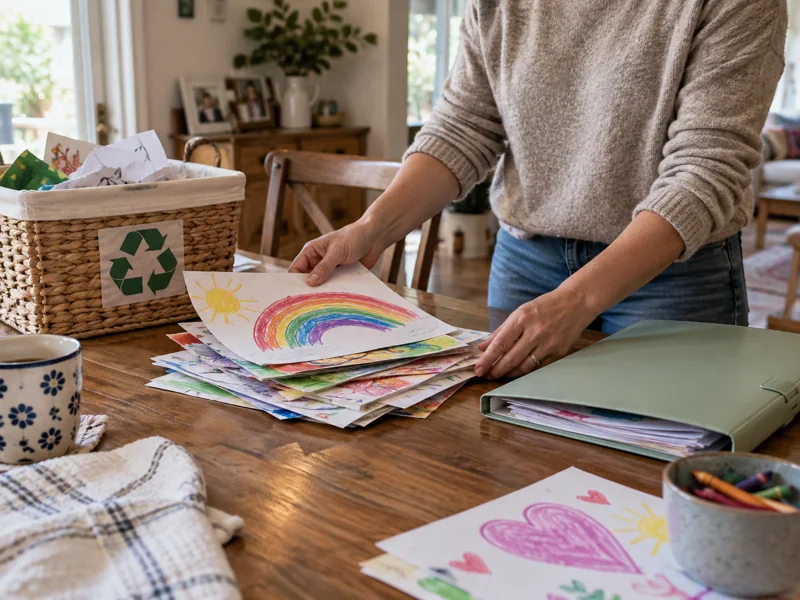
The drawing arrives with ceremony. It is handed to you while the marker is still damp, and of course it matters. By Thursday, there are eleven more on the counter, three in a backpack, and one with a suspiciously sticky corner. Keeping every page is not the only way to respect the work.
A simple system gives artwork four possible destinations: display, review, keep, or let go. The important part is making the choice while you can still see the kitchen counter.
Set up one landing place
Choose a shallow tray or folder where new artwork waits. Do not mix it with permission slips or bills. A physical limit makes the pile visible before it becomes a permanent exhibit. If papers of every kind currently land together, pair this with a no-buy after-school drop zone.
You do not need a new organizer. A reused folder and one empty wall space are enough.
Display the current favorites
Pick a small display area: a magnetic strip, two frames that open easily, or one corkboard. Let the child choose a current favorite when possible. Rotating the display is a more honest way to appreciate the work than storing everything unseen in a giant box.
Put a date on the back if the age or moment matters. Avoid writing over the drawing itself. If the child wants to tell you the story behind it, note one sentence on the reverse while the memory is fresh.
Review the tray together, briefly
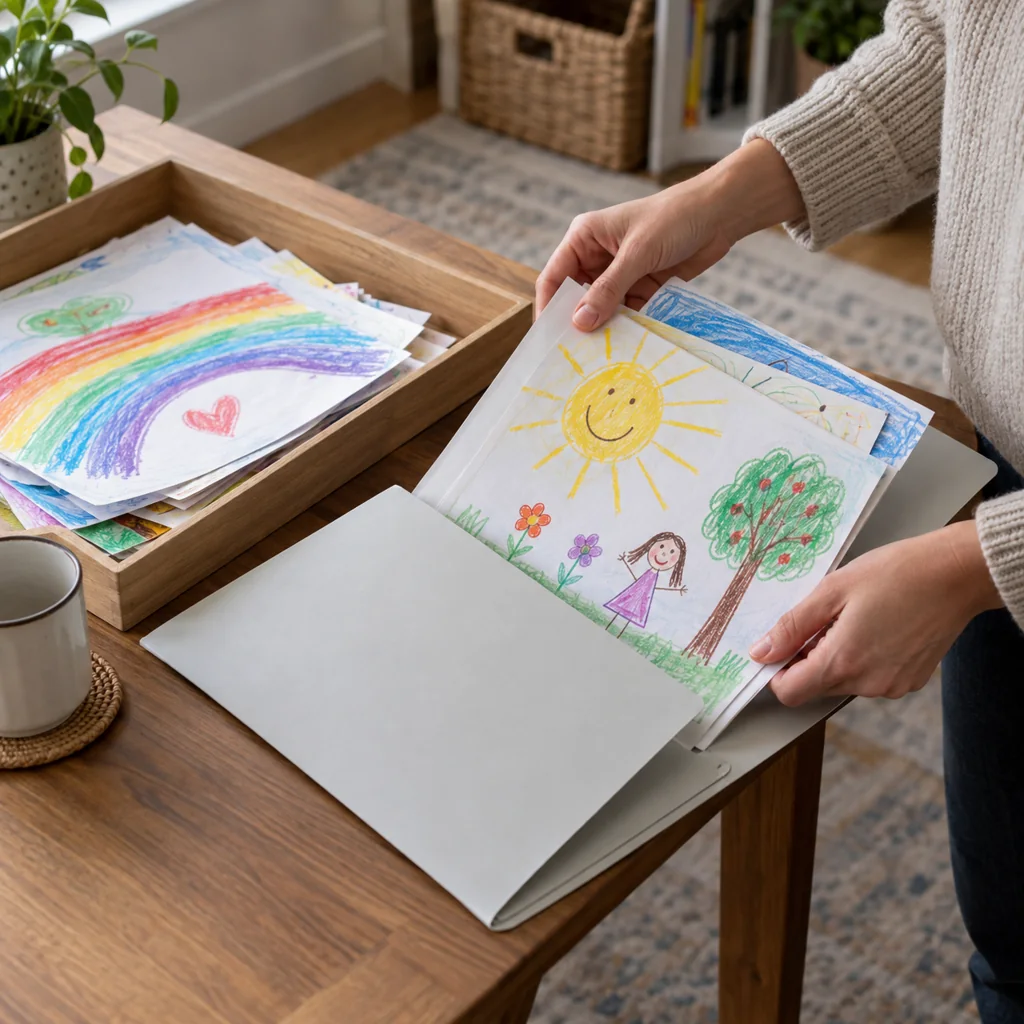
Once a week or once a month, empty the landing place. Ask which pieces the child wants to display or keep. You can choose one too. Some pages are experiments, practice marks, or duplicates; letting those go is not a judgment on the child.
For a child who finds discarding difficult, try a temporary “maybe” folder with a clear review date. Do not turn “maybe” into a second unlimited archive.
Keep a small physical collection
One slim folder per child per school year is a workable starting boundary. It can hold a few pieces that show a new skill, tell a family story, or are genuinely loved. Oversized projects may need a separate choice: photograph them, display them for a while, or keep one representative piece.
Capacity is a design choice, not a rule about how much affection a child deserves. The same principle helps with toy organization in a shared living room: give valued things a space you can actually maintain.
Photograph only what you will be able to find
A quick phone photo can preserve a project without preserving every sheet, but a camera roll full of unnamed images is just another pile. Use one album per child and year, take the photo in good light, and back up the album using a service you trust. Avoid including a child’s full name, school, or other private details if you might later share the image.
A photograph is not mandatory. Some work is meaningful because it was enjoyed for a day and then finished.
What to do with gifts for relatives
Ask before sending stacks of paper. A grandparent might welcome one favorite drawing or a small seasonal card. If a piece leaves the house, it should be a gift the recipient wants, not storage you have outsourced.
A ten-minute reset
- Gather loose artwork into the tray.
- Return school forms to the family admin spot.
- Rotate one display piece.
- Choose a few physical keepsakes.
- Photograph selected oversized projects if useful.
- Recycle the remaining paper when appropriate.
Pair the paper decision with the family admin hour so it does not become a separate Sunday project.
When feelings are bigger than the paper
If a child is upset, pause. Explain that the display and folder have room for favorites, and invite them to choose. Do not secretly discard a piece they have clearly claimed as important. The goal is a respectful routine, not winning an argument over construction paper.
Quick questions
Should I save the first of everything?
Save what tells a story you care about. “First” can be meaningful, but keeping every first does not make the memory stronger.
What if the child wants every piece?
Use a temporary review folder and revisit later. Offer a fixed display space and a fixed keepsake space so the choice is concrete rather than abstract.